Asylum Work Permits Are Taking Longer Than Ever – Here’s What’s Happening and How to Stay Safe
If you have applied for asylum in the United States, you probably also applied for an Employment Authorization Document (EAD). That little card lets you work legally while you wait for your asylum case to be decided. Right now, hundreds of thousands of people are stuck waiting for these work permits. New government rules passed in 2025 and 2026 are making the delays even worse — and adding some serious new risks.
Here is a clear, plain-language look at the latest numbers, why things are so slow, and what you need to watch out for in the coming months.
The Huge Backlog Right Now
According to the official U.S. Citizenship and Immigration Services (USCIS) report for July–September 2025:
- Total asylum EAD applications still waiting (as of September 30, 2025): 217,898
- Initial applications waiting: 117,700
- Renewal applications waiting: 100,198
That is just the asylum-related work permits. When you add up all types of EAD applications across every category, the national backlog is 1,696,897 cases. Asylum cases make up about 13% of the entire pile.
USCIS is approving a lot of cases each quarter, but new applications keep coming in and old ones keep piling up. Many people have been waiting months — sometimes over a year.
Why Everything Is Moving So Slowly
Several big changes are causing extra delays:
- High-Risk Country Holds Starting January 1, 2026, USCIS put most pending immigration cases on “hold” if the person was born in, is a citizen of, or has documents from one of about 39 “high-risk” countries (including Afghanistan, Iran, Venezuela, Haiti, Cuba, and many others in Africa, the Middle East, and Latin America). Even people who now have a different passport can be affected if their country of birth is on the list. These cases get extra security checks, interviews, and reviews. The only good news for asylum seekers: initial asylum EADs (category c(8)) are supposed to be processed in 30 days because of a court order. Renewals and other categories are more likely to sit on hold for a long time.
- Extra Screening and Vetting USCIS is doing more background checks, social-media reviews, fingerprint checks, and re-interviews for many people. They started a program called Operation PARRIS to dig deeper into some cases. All of this takes extra time.
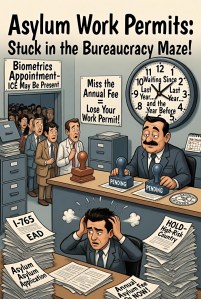
- The New Annual Asylum Fee — A Big Warning Beginning May 29, 2026, anyone with a pending asylum application must pay an Annual Asylum Fee every calendar year.
- If you miss the payment or do not pay within 30 days after USCIS sends you a notice, they will reject your asylum case.
- They will also deny any pending EAD and cancel any EAD you already have.
- If you do not have legal status, they can start removal (deportation) proceedings.
This fee rule could cause thousands of pending EADs to disappear almost overnight. People who were waiting months could suddenly lose their work permission.
Biometrics Appointments: You Must Go — But Be Prepared
USCIS still requires most people to attend a biometrics appointment (where they take your fingerprints and photo). You have to show up — skipping it can cause your whole case to be denied.
Important new risk: Immigration lawyers are reporting a sharp increase in people being detained by ICE right at the biometrics office. This is happening across the country, including for people applying for work permits.
Who seems to be at higher risk?
- People with any prior removal order (even old ones)
- Anyone who has had contact with law enforcement in the past
- Cases that show up on the biometrics notice with the code “I-862 – Notice to Appear”
Even if you have never been in formal removal proceedings, ICE may still detain you at the appointment.
What you should do:
- Bring a trusted friend or family member with you if possible.
- Have the phone number of an immigration lawyer ready.
- Know your rights: you do not have to answer questions beyond what is needed for the biometrics.
- If you think you might be at risk, talk to a lawyer before the appointment.
What Should You Do Now?
- Pay the Annual Asylum Fee on time once you get the notice — set a reminder.
- Keep your address updated with USCIS so you do not miss any letters.
- Attend every biometrics appointment — but go prepared.
- Stay in touch with a qualified immigration lawyer who follows these fast-changing rules.
- Check the USCIS website regularly for updates on processing times and new notices.
The asylum EAD system is under a lot of pressure right now. Backlogs are large, new rules are adding delays, and enforcement actions are increasing. Knowing what is happening can help you protect your case and your ability to work while you wait.
If your EAD is pending or you have an upcoming biometrics appointment, talk to an immigration attorney right away. The rules are changing quickly, and small mistakes can have big consequences.
Recent Post
-
 When the Foundation Cracks: OPT Fraud, the H-1B Pipeline, and the Risk of Losing Everything
 -
 Sixth Circuit Rules: Detained Immigrants in Ohio Have the Right to a Bond Hearing – And If You Were Denied, You May Be Able to Apply Again
 -
DENATURALIZATION AND IMMIGRATION CONSEQUENCES IN FEDERAL HEALTHCARE AND BENEFITS FRAUD CASES
-
USCIS Delays in Asylum Processing
-
NEW USCIS TASK FORCE CREATED TO TARGET GREEN CARDS, VISAS AND CITIZENSHIP